
Website and content
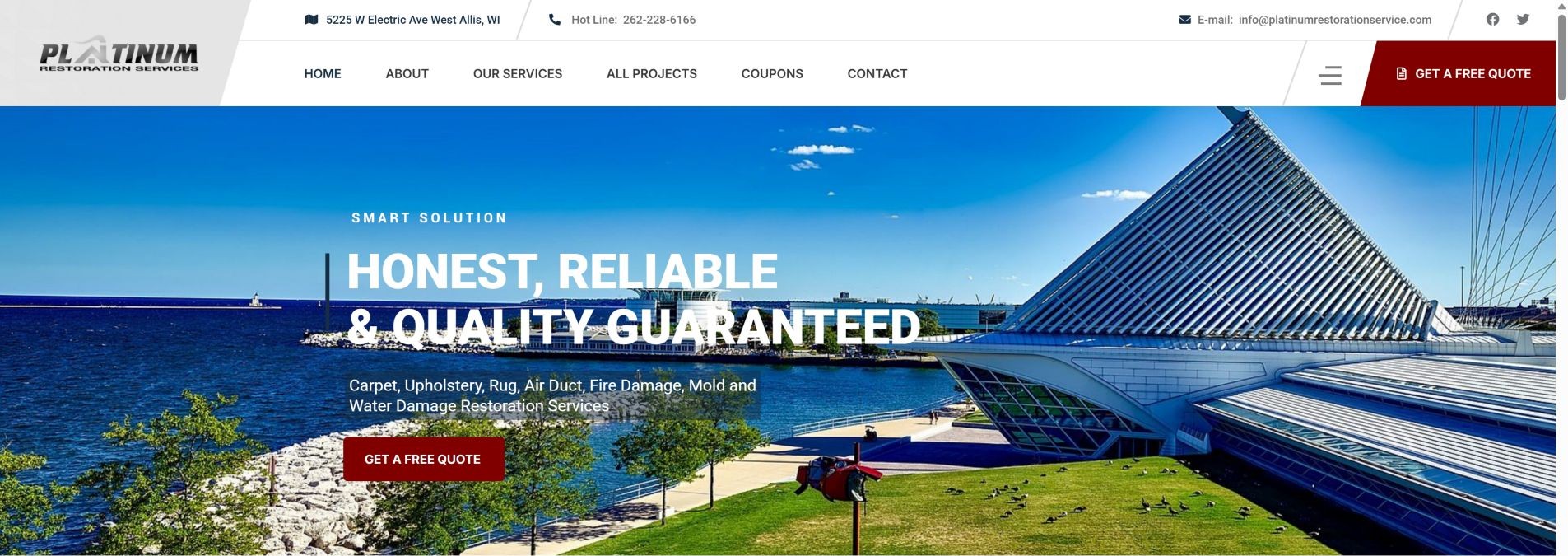
The existing WordPress site was recovered without replacing the business's identity. Malicious changes were removed, useful content was preserved, and secure website routing was repaired.
Recovery & asset security · Platinum Restoration Services
About five hours of hands-on recovery and security work helped Jeremy regain his website—and his confidence after two hacks in one year.
We worked through account access, cleanup, migration, email, former-provider permissions, and recovery settings. The result was a recovered business website with stronger protection across the connected assets.
About 5 hours Hands-on recovery & security work
Existing website Content and identity preservedConnected assets Hosting, domain, email & accountsAn urgent business interruption
Gambling content and malicious injections caused Google to disapprove Jeremy's ads and added verification work. His damaged website had cut off the source of new customer calls he depended on.
Jeremy told us those ads were his only means of bringing in new calls. For a local cleaning and restoration business, that turned an unfamiliar technical problem into an immediate business concern. He had already experienced two hacks that year before finding us.
Getting the website back was the first priority. Regaining control of the assets around it was essential to giving Jeremy confidence in the recovery. We worked through the scattered access with him, preserved his existing content, and followed the repair into hosting, DNS, email, and connected Google accounts.
That estimate covers gaining access, cleaning the site, migrating hosting and email, strengthening account controls, removing obsolete access across several properties, and the related email-security work.
The recovery work
A clean homepage was one part of the job. The business also needed dependable email, appropriate account access, stronger hosting protection, and a practical recovery path.
Work with the owner to locate domain, hosting, and WordPress access, then establish the management roles needed to complete the recovery and provide ongoing care.
Remove the hacked changes, preserve useful content, correct domain and HTTPS routing, and investigate the recurrence instead of stopping at the first visible repair.
Move the cleaned site, DNS, and business email to managed hosting. Retain recovery backups and preserve the owner's familiar Gmail workflow.
Remove former-provider access while preserving content, review recovery settings and permissions, and extend protection through server scanning and ongoing email care.
Security across the assets
The existing WordPress site was recovered without replacing the business's identity. Malicious changes were removed, useful content was preserved, and secure website routing was repaired.
The cleaned website moved to Elevel3 hosting protected by Imunify360, including real-time malware scanning for malicious files, viruses, and related threats on the hosting layer.
Domain routing and DNS management were brought into the recovery, with the website and email records maintained together. HTTPS access and redirects were checked.
Email history and forwarding arrangements were preserved during migration so Jeremy could keep working in Gmail. Delivery checks confirmed the migrated email route worked.
Obsolete provider access was removed across several properties. Website content was retained, account roles were reviewed, and unrecognized recovery access was addressed.
Recovery copies were retained and a stronger maintenance foundation established. The owner now has recovery options and experienced people available to respond if something goes wrong.
Email is part of the security boundary
A phishing email can threaten the same accounts used to run the business.
We reviewed the migrated mail archive and scanned attachment copies safely. Confirmed malicious messages and a credential-phishing message were quarantined without deleting the retained mail history. Suspicious content was inspected without executing attachments or following its payload links.
We also reviewed Gmail security settings and suspicious messages, preserved existing spam protections, and established delegated management access. That allows assistance through the appropriate account roles instead of repeatedly sharing the owner's login.
Ongoing email care includes AI-assisted phishing review through our Recurring Email service. It adds context-aware review of suspicious messages to the broader protection plan, alongside the existing spam filtering and the server's Imunify360 website protection.
The outcome
After two hacks in one year, Jeremy had his existing website recovered, his email workflow preserved, and a stronger security and recovery foundation around the business.
The value was in following the connections: hosting, domains, email, Google accounts, old permissions, backups, and the website itself. Those assets work together, and protecting the business means paying attention to how they connect.
Our commitment is to high-end security measures, real-time malware scanning, prepared disaster-recovery options, retained backups, and experienced people who can respond. No provider can promise another attack is impossible. A business can have much stronger protection and a practical way to recover.
Recovery work completed November 4–5, 2026. Approximately five hours refers to the hands-on recovery and security effort in this case. The focus here is restoration, control, and protection of the connected business assets.
Has a hack interrupted your business?
Tell Brian what changed, which accounts you can access, and whether your hosting or advertising provider has flagged the site.
Please don't email passwords. We'll arrange the access needed after we talk.